

Imagine finding a prime UK property investment. An undervalued terrace at auction or a commercial conversion with massive yield potential, only to watch the opportunity slip through your fingers because traditional mortgage underwriting is moving at a snail’s pace. Or picture being stuck in a property chain on the verge of collapse because a buyer lower down lost their mortgage approval at the eleventh hour.
In the fast-moving UK real estate market, timing isn’t just everything; it’s often the difference between a lucrative deal and a costly missed opportunity.
This is where bridging finance for property becomes an indispensable tool. Functioning as a short-term financial bridge, these specialist loans grant developers, landlords, and homebuyers immediate access to capital when conventional lenders are simply too slow.
In this guide, we break down exactly how property bridging loans work in the UK, when you should use them, the hidden costs to watch out for, and how working with an independent broker can help you secure the most competitive rates on the market.
What is Bridging Finance for Property and How Does It Work?
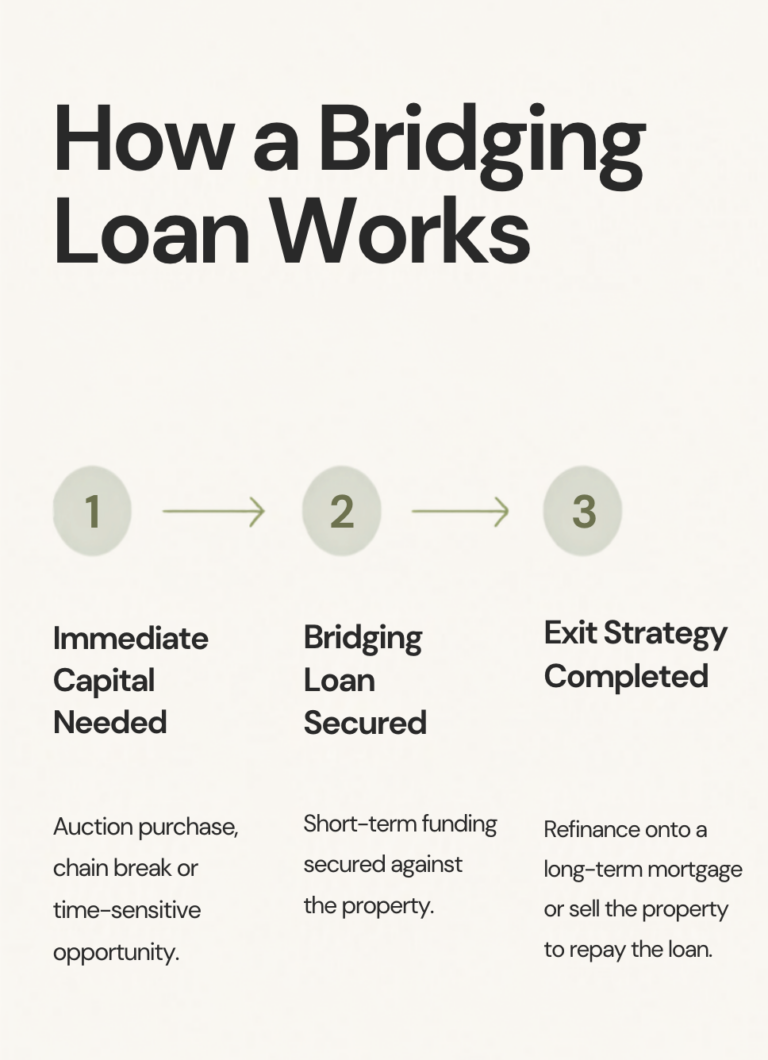
At its core, a property bridging loan in the UK is a short-term, asset-backed loan designed to “bridge” a temporary financial gap. Unlike standard residential or commercial mortgages which can take anywhere from 8 to 12 weeks to complete, a bridging facility
can often be secured in a matter of days.
Bridging loans are typically secured against real estate (residential, commercial, or mixed-use) and run for terms ranging from 1 to 24 months. As they’re designed for short-term use, interest rates are calculated monthly rather than annually.
The Role of the Exit Strategy
Unlike mainstream lenders who assess your long-term affordability based on personal or business income, bridging lenders focus heavily on two things:
- The value of the underlying asset used as security.
- Your exit strategy. The clear, viable plan for how the loan will be repaid in full.
A viable exit strategy is the single most important element of any bridging loan application. Typical exits include:
- Refinancing onto a long-term facility: Switching to a buy-to-let mortgage or a standard commercial loan once the property is renovated or tenanted.
- Sale of the property: Selling the refurbished or developed asset on the open market to clear the debt and realise your profit.
- Sale of another asset: Using proceeds from the sale of another property or business investment.
Key Scenarios: When Should You Use a Property Bridging Loan?
Bridging finance is a tactical financial product. While it carries higher interest rates than long-term debt, the speed and flexibility it offers can unlock profit margins that far outweigh the borrowing costs. Here are the most common scenarios where bridging loans prove invaluable:
1. Rescuing Property Chain Breaks
A property chain break occurs when one sale in an interconnected sequence of transactions fails, threatening to collapse all dependent sales. If you are selling a property to fund your next purchase and your buyer pulls out, a residential bridging loan allows you to complete your acquisition without waiting to find another buyer. Once your original property eventually sells, the proceeds repay the bridging loan.
2. Winning at Property Auctions
Property auctions require speed and discipline. When the gavel falls on a winning bid, you enter a binding contract that typically requires a 10% deposit immediately and full completion within 20 to 28 days. Standard mortgage providers rarely process applications that quickly. Fast property finance through a specialist bridging lender ensures you meet strict auction deadlines and avoid losing your deposit.
3. Un-mortgageable Properties
High-street banks have strict criteria regarding a property’s habitability. If a building lacks a functional kitchen or bathroom, has severe structural issues, or is in an advanced state of disrepair, traditional mortgage lenders will refuse to lend.
A bridging loan provides the upfront capital to acquire the un-mortgageable site and complete the necessary light or heavy refurbishments. Once the building meets standard habitability criteria, you can refinance onto a long-term commercial or buy-to-let mortgage.
4. Heavy and Light Property Refurbishments
Property investors and developers frequently use commercial bridging loans to add value to real estate portfolios:
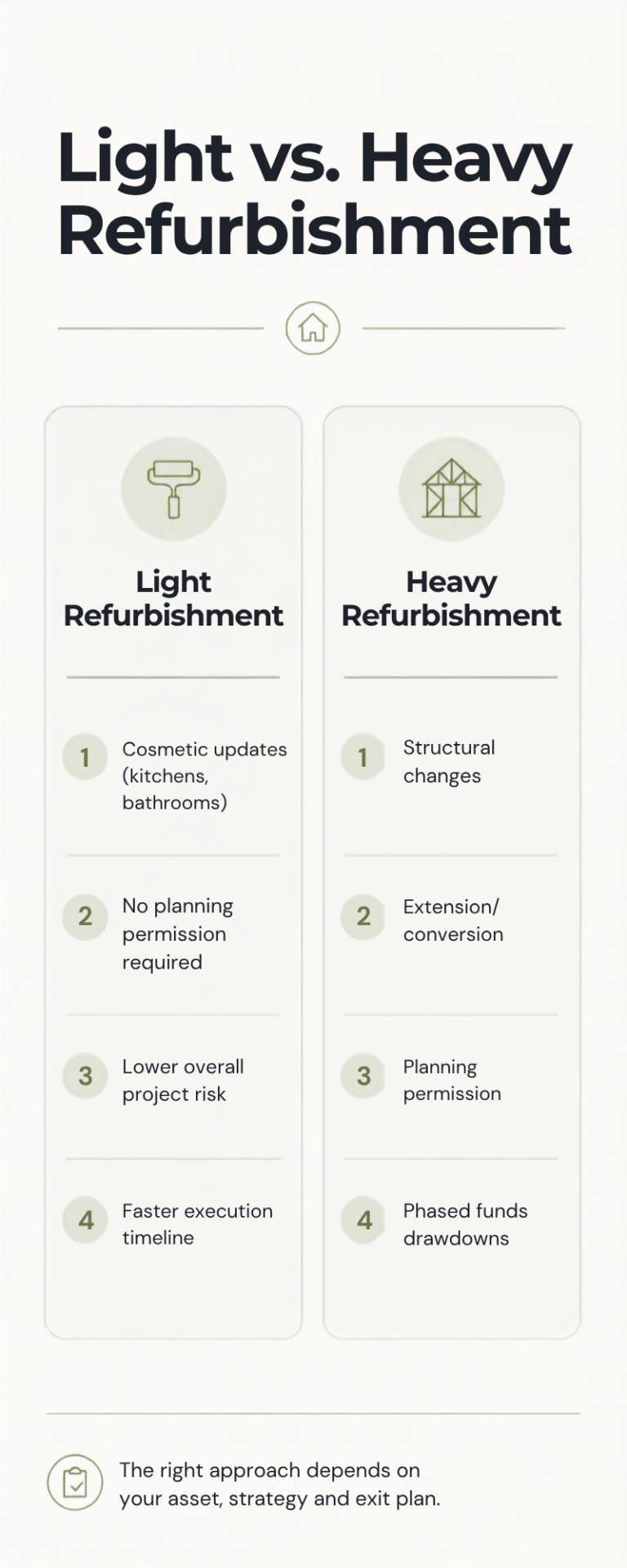
- Light Refurbishment: Non-structural cosmetic upgrades (painting, new kitchens, bathrooms, modern heating) that don’t require planning permission.
- Heavy Refurbishment: Major structural alterations, extensions, conversion of commercial premises into residential units (PDR), or full internal reconfigurations requiring planning approval and building control sign-offs.
Open vs. Closed Bridging Loans: Understanding the Difference
When exploring bridging loans, you will encounter two primary structures: open bridging loans and closed bridging loans. The distinction lies entirely in the clarity and timing of your exit strategy.
Feature | Closed Bridging Loan | Open Bridging Loan |
Exit Date | Fixed, contractually agreed completion date. | Flexible end date within the overall loan term. |
Exit Certainty | High (e.g., exchange of contracts completed on a sale). | Lower (e.g., property is on the market, but not yet sold). |
Lender Risk | Lower risk for the lender. | Higher risk for the lender. |
Pricing | Often lower interest rates and fees. | Slightly higher interest rates due to uncertainty. |
Best Used For | Chain breaks with exchanged contracts or fixed refinance dates. | Auction purchases or speculative developments. |
Closed Bridging Loans
A closed bridging loan has a fixed, predetermined repayment date. This option is typically used when you have already exchanged contracts on the sale of an existing property and have a firm completion date set. Because the lender carries less risk, closed bridging loans usually come with lower interest rates.
Open Bridging Loans
An open bridging loan offers greater flexibility, with no rigid repayment date specified upfront, though the loan must still be settled within the agreed maximum term (usually 12 months). This structure suits investors buying at auction or launching a refurbishment project where the precise sale date or refinance completion remains variable.
Key Costs to Consider When Securing Bridging Finance
To accurately evaluate whether a property bridging loan makes financial sense, you must look beyond the headline interest rate and calculate the total cost of capital.
Expert Note: Bridging interest rates are quoted on a monthly basis (typically ranging from 0.55% to 1.5% per month), making direct comparison with annual percentage rates (APR) misleading if you do not account for the short loan duration.
1. Interest Payment Structures
Bridging lenders offer three distinct methods for handling monthly interest:
- Monthly Serviced Interest: You pay the interest charge each month from income, similar to a standard interest-only mortgage.
- Rolled-Up Interest: Interest accrues monthly and is added to the total loan balance, paid in full at the end of the term. This preserves cash flow during construction or refurbishment phases.
- Retained Interest: The lender calculates the total interest for the expected loan term upfront and deducts it from the gross loan advance. If you exit the loan early, unused retained interest is typically credited back to you.
2. Associated Lenders and Third-Party Fees
Beyond monthly interest, budget for these key transaction costs:
- Facility/Arrangement Fees: Charged by the lender for setting up the facility, typically 1% to 2% of the gross loan amount.
- Valuation Fees: Covers a specialist commercial or residential surveyor inspecting the property on behalf of the lender.
- Legal Fees: You are responsible for paying both your own legal costs and the lender’s independent legal team costs.
- Exit Fees: Some lenders charge a fee (usually 1% of the loan value) when you pay off the facility, though many competitive lenders now waive exit charges altogether.
How an Independent Commercial Broker Speeds Up Your Application
Navigating the UK bridging finance sector without specialist guidance can be slow, confusing, and unexpectedly expensive. Unlike retail banking, the bridging market comprises dozens of private funds, niche lenders, and family offices, many of which do not accept direct, unrepresented applications from the public.
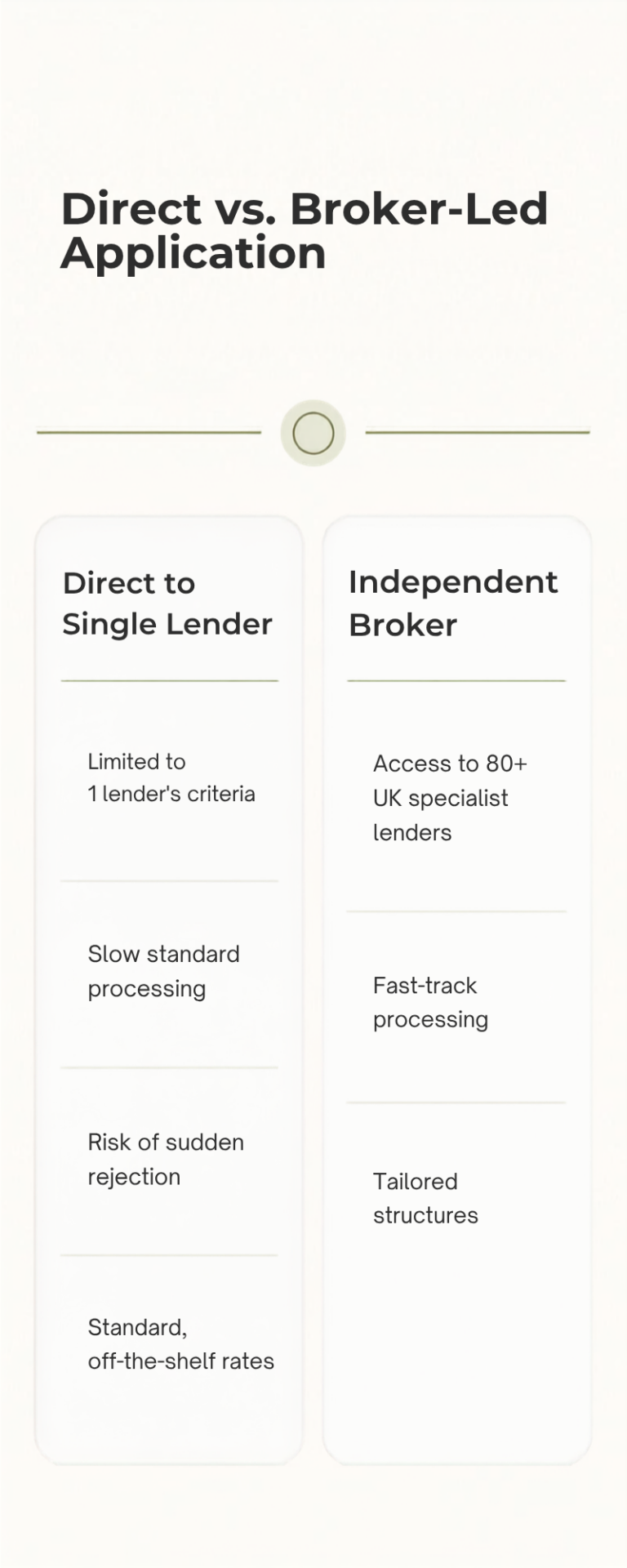
Partnering with an independent broker like Commercial Finance Expert provides significant strategic advantages:
Access to Whole-of-Market Rates
Specialist brokers maintain real-time visibility over terms, pricing shifts, and underwriting appetites across the entire UK market. This enables them to structure your loan precisely to your situation, matching high-leverage requirements or complex property types with the right funding partner.
Rapid Execution and Fast-Tracking
When an auction deadline or chain collapse demands turnaround times measured in days, an experienced broker knows which underwriters can move instantly. They curate your documentation package up front, avoiding back-and-forth delays and ensuring your file moves straight to approval.
Negotiating Tailored Loan Terms
From waiving exit fees to structuring rolled-up interest options that protect working capital, commercial finance brokers negotiate terms on your behalf to minimize overall project expenditure.
If you are facing a tight completion deadline or need fast capital to secure a profitable property deal, speak with a dedicated advisor today.
Unlock Capital Fast with Commercial Finance Expert
Bridging finance for property is a powerful financial tool that turns tight deadlines into strategic advantages. Whether you are navigating an unexpected chain break, acquiring commercial premises at auction, or managing a large-scale property conversion, the right bridging loan delivers the speed and flexibility traditional banks simply cannot match.
At Commercial Finance Expert, we specialise in structuring fast property finance tailored around your project’s specific goals and exit strategies. As an independent broker, we scan the market to secure competitive monthly rates, flexible repayment structures, and swift completions.
Don’t let time sensitive property opportunities pass you by. Contact our expert team today to discuss your requirements, explore your exit strategy, and secure a bespoke, no-obligation bridging quote tailored to your investment plan.
Bridging Finance For Property
Fast, Flexible Bridging Loans for Property Professionals in Nottingham & East Midlands